Search This Blog

Showing posts with label Operation Crossroads. Show all posts

Phase One of NAS Barbers Point support of atomic bomb development – some aspects still classified

 Compiled By Ewa Historian John Bond

Phase One of NAS Barbers Point support of atomic bomb development – some aspects still classified

A little known fact is that the Atomic Energy Commission (AEC) leased land at NAS Barbers Point for supporting atomic bombs testing. Operation Crossroads - on Pacific Islands in 1946 was a highly publicized Navy sponsored atomic bomb demonstration; however this led to all later early Pacific bomb tests to be run by the atomic Energy Commission (AEC.)  

The atomic bombs tests brought back a lot of contaminated material to Hawaii and to places like Treasure Island, San Francisco which have been dealing with this legacy for a very long time. Many aspects of NAS Barbers Point Site 95 bomb testing operations remains classified even today.

NAS Barbers Point was part of the MANHATTAN ENGINEER DISTRICT (1945-1946) which grew out of the original Top Secret Manhattan Project that produced two atomic bombs during WW-II. The Barbers Point naval airbase was called “Site 95.”

March 1999 Historical Radiological and Survey Plan NAS Barbers Point

This survey done as part of the Base Realignment and Closure process (BRAC) to turn the Site 95 site over to the State Department of Hawaiian Homelands (DHHL) to scan for remaining radioactive materials that may still be remaining from the bomb testing operations by the Navy and AEC.

Historic Note: The director of the Manhattan Atomic Bomb project, General Leslie Groves, was stationed at Schofield Barracks in Hawaii in the early 1920’s and earned a commendation for his work there, constructing a trail from Kahuku to Pupukea.

Area 95 in 1967 after it had been turned over to the Navy for special weapons storage. The very high double fencing indicates nuclear weapons storage. Buildings at left are 278 and 1682.

1965 photo shows circular “hot pad’ alongside runway 29 for special weapons and road going to high security storage area which after base closure became Kalaeloa Hawaiian Heritage Park. Ironically the Hawaiian cultural park had to be closed because large amounts of toxic soil was allowed to be brought in and dumped for use as land fill. This caused numerous illegal dumping citations and expensive remediation measures.

NAS Barbers Point Area 95 in 1980’s. The AEC leased site was turned over to the Navy in 1977.

The history of atomic weapons development and deployment at NAS Barbers Point was in three phases:

Phase One : – 1946 –Operation Crossroads Navy sponsored Pacific Bomb tests

Phase Two: Atomic Energy Commission acquires NASBP property leases for major 1960’s bomb tests – such as Operation Dominic, and many others.

Phase Three: Navy begins massive deployment of nuclear weapons on carrier aircraft, ASW patrol aircraft with large numbers stored on Barbers base, West Loch, Waikele and Lualualei

The Manhattan District was a major nationwide operation to develop atomic weapons. NAS Barbers Point was not listed because most of its operations are still classified.

Nuclear bomb testing took place all over the central Pacific islands and other bomb tests were run by France near Tahiti and by the United Kingdom near Australia.

The Manhattan Project later became absorbed by the AEC – Atomic Energy Commission

NAS Barbers Point supported all major Pacific bomb tests

https://www.osti.gov/opennet/manhattan-project-history/Events/1945-present/med_45-46.htm

With the end of the Second World War, American policymakers anticipated that the Manhattan Project’s infrastructure would be turned over to and managed by a largely civilian commission.  General Leslie Groves initially thought this would happen soon after the ending of hostilities.  His strategy for interim management of the complex was thus one of "hold the line," where he sought to maintain the essential soundness of the physical plant and the personnel that ran it, complete ongoing construction, and promote efficiency and economy. 

Lieutenant General Leslie Richard Groves Jr. (17 August 1896 – 13 July 1970) was a United States Army Corps of Engineers officer who oversaw the construction of the Pentagon and directed the Manhattan Project, a top secret research project that developed the atomic bomb during World War II. After the war, Groves remained in charge of the Manhattan Project until responsibility for nuclear weapons production was handed over to the United States Atomic Energy Commission in 1947. In November 1922, Groves received his first overseas posting, as a company commander with the 3rd Engineers at the Schofield Barracks in Hawaii. He earned a commendation for his work there, constructing a trail from Kahuku to Pupukea.


Manhattan Project

https://en.wikipedia.org/wiki/Manhattan_Project

Two Fat Man-type detonations were conducted at Bikini Atoll in July 1946 as part of Operation Crossroads to investigate the effect of nuclear weapons on warships. Able was detonated on 1 July 1946. The more spectacular Baker was detonated underwater on 25 July 1946.

Following a domestic debate over the permanent management of the nuclear program, the United States Atomic Energy Commission (AEC) was created by the Atomic Energy Act of 1946 to take over the functions and assets of the Manhattan Project. It established civilian control over atomic development, and separated the development, production and control of atomic weapons from the military. Military aspects were taken over by the Armed Forces Special Weapons Project (AFSWP).Although the Manhattan Project ceased to exist on 31 December 1946, the Manhattan District was not abolished until 15 August 1947.

Pacific Proving Grounds

https://en.wikipedia.org/wiki/Pacific_Proving_Grounds

The Pacific Proving Grounds was the name given by the United States government to a number of sites in the Marshall Islands and a few other sites in the Pacific Ocean at which it conducted nuclear testing between 1946 and 1962. The U.S. tested a nuclear weapon (codenamed Able) on Bikini Atoll on June 30, 1946. This was followed by Baker on July 24, 1946.

The United States conducted 105 atmospheric and underwater (i.e., not underground) nuclear tests in the Pacific, many of which were of extremely high yield. While the Marshall Islands testing composed 14% of all U.S. tests, it composed nearly 80% of the total yields of those detonated by the U.S., with an estimated total yield of around 210 megatons, with the largest being the 15 Mt Castle Bravo shot of 1954 which spread considerable nuclear fallout on many of the islands, including several which were inhabited, and some that had not been evacuated.

Many of the islands which were part of the Pacific Proving Grounds are still contaminated from the nuclear fallout, and many of those who were living on the islands at the time of testing have suffered from an increased incidence of various health problems. Through the Radiation Exposure Compensation Act of 1990, at least $759 million has been paid to Marshall Islanders as compensation for their exposure to U.S. nuclear testing. Following the Castle Bravo accident, the U.S. paid $15.3 million to Japan.

Operation Crossroads (1946) The "Baker" shot of Operation Crossroads

 in 1946 was an underwater shot.

The first use of the Pacific Proving Grounds was during Operation Crossroads, the first nuclear testing done after the atomic bombing of Hiroshima and Nagasaki. Two fission bombs, both with a yield of 21 kilotons, were tested at Bikini Atoll. "Able" was detonated at an altitude of 520 ft. on July 1, 1946, and "Baker" was detonated at a depth of 90 ft. underwater on July 25. Both tests used a flotilla of obsolete vessels from World War II with the intent of learning the effects of nuclear weapons on naval fleets. The "Baker" shot created a large condensation cloud and spread much more radioactive water onto the ships than was expected; many of the surviving ships became too "hot" to be used or decontaminated and eventually had to be sunk.


The bomb drops in Operation Crossroads was from “Dave’s Dream”

a B-29 based in the Marianas Islands


Atomic Energy Commission

https://en.wikipedia.org/wiki/United_States_Atomic_Energy_Commission

The United States Atomic Energy Commission, commonly known as the AEC, was an agency of the United States government established after World War II by U.S. Congress to foster and control the peacetime development of atomic science and technology.[4] President Harry S. Truman signed the McMahon/Atomic Energy Act on August 1, 1946, transferring the control of atomic energy from military to civilian hands, effective on January 1, 1947.[5] This shift gave the members of the AEC complete control of the plants, laboratories, equipment, and personnel assembled during the war to produce the atomic bomb.


Operation Crossroads was supported by NAS Barbers Point in 1946


Compiled By Ewa Historian John Bond

Operation Crossroads was supported by 

NAS Barbers Point in 1946

Operation Crossroads - on Pacific Islands in 1946 was a Navy sponsored atomic bomb demonstration.  The atomic bombs tests brought back a lot of contaminated material to Hawaii and to places like Treasure Island, San Francisco have been dealing with this legacy for a very long time. A lot of Site 95 bomb testing legacy remains classified even today. A little known fact is that the Atomic Energy Commission (AEC) leased land at NAS Barbers Point for supporting Pacific atomic bomb testing.

NAS Barbers Point was part of the MANHATTAN ENGINEER DISTRICT (1945-1946) which grew out of the original Top Secret Manhattan Project that produced two atomic bombs during WW-II. The Barbers Point naval airbase was called “Site 95.”

https://en.wikipedia.org/wiki/Operation_Crossroads

Operation Crossroads was a pair of nuclear weapon tests conducted by the United States at Bikini Atoll in mid-1946. They were the first nuclear weapon tests since Trinity in July 1945, and the first detonations of nuclear devices since the atomic bombing of Nagasaki on August 9, 1945. The purpose of the tests was to investigate the effect of nuclear weapons on warships.


A series of three tests was recommended to study the effects of nuclear weapons on ships, equipment, and materiel. Timing was critical because Navy manpower required to move the ships was being released from active duty as part of the post-World War II demobilization, and civilian scientists knowledgeable about atomic weapons were leaving federal employment for college teaching positions.


Prospective Operation Crossroads target ships and support ships

at Pearl Harbor on February 27, 1946

The Crossroads tests were the first of many nuclear tests held in the Marshall Islands, and the first to be publicly announced beforehand and observed by an invited audience, including a large press corps. They were conducted by Joint Army/Navy Task Force One, headed by Vice Admiral William H. P. Blandy rather than by the Manhattan Project. A fleet of 95 target ships was assembled in Bikini Lagoon and hit with two detonations of Fat Man plutonium implosion-type nuclear weapons of the kind dropped on Nagasaki, each with a yield of 23 kilotons of TNT.

Bikini's native residents agreed to evacuate the island, and were evacuated on board the LST-861, with most moving to the Rongerik Atoll. 

Pressure to cancel Operation Crossroads altogether came from scientists and diplomats. Manhattan Project scientists argued that further testing was unnecessary and environmentally dangerous. A Los Alamos study warned "the water near a recent surface explosion will be a witch's brew" of radioactivity.[15] When the scientists pointed out that the tests might demonstrate ship survivability while ignoring the effect of radiation on sailors, Blandy responded by adding test animals to some of the ships, thereby generating protests from animal rights advocates.

Operation Crossroads was the first operation in which take-off, flight, and landing were accomplished with no one aboard.  The feat was an impressive one; many experts had thought it could never be accomplished with planes of this size.’

These were the experiments that captured the imagination of Hanson Baldwin, a military affairs correspondent for the New York Times and Life magazine.  He had already predicted that ‘robot planes, rockets, television and radar bombing and atomic bombs will do the work today done by fleets of thousands of piloted bombers.’

Back to the future.  As soon as the bomb was released over Bikini the first B-17 control aircraft turned its huge drone (Fox) into the cloud at an altitude of 24,000 feet; Fox was then switched to its automatic pilot, entering the cloud eight minutes after the explosion, while the control (or “beeper”) aircraft raced around the cloud and resumed control when the drone emerged on the other side.  Fox was followed by George (at 30,000 feet), How (at 18,000 feet) and Love (at 12,000 feet).  All four drones were directed back to Eniwetok atoll where they were handed back to the ground controllers in jeeps at the end of the runway who taxied them to the radiological safe area where the filters and bags were removed and flown to Los Alamos Laboratory for analysis .

In the 1950s, a series of large thermonuclear tests rendered Bikini unfit for subsistence farming and fishing because of radioactive contamination. Bikini remains uninhabited as of 2017, though it is occasionally visited by sport divers. Planners attempted to protect participants in the Operation Crossroads tests against radiation sickness, but one study showed that the life expectancy of participants was reduced by an average of three months. 

The Baker test's radioactive contamination of all the target ships was the first case of immediate, concentrated radioactive fallout from a nuclear explosion. Chemist Glenn T. Seaborg, the longest-serving chairman of the Atomic Energy Commission, called Baker "the world's first nuclear disaster."

Bikini A-Bomb Tests July 1946

https://nsarchive.gwu.edu/briefing-book/environmental-diplomacy-nuclear-vault/2016-07-22/bikini-bomb-tests-july-1946

Navy film footage depicting the removal of Pacific Islanders from Bikini atoll on March 6/7, 1946

https://www.youtube.com/watch?v=w-cw2ZfCGHg

In February 1946, Commodore Ben Wyatt, the Marshall Island’s military governor, informed the Bikinians that they must leave so that the U.S. government could conduct military tests “for the good of mankind.” On 7 March 1946 the Navy transported the Bikinians to Rongerik Island where, as it turned out, food and water were in short supply.

https://www.youtube.com/watch?v=XG0Gxy5t0yg

Massive atomic explosion destroys and contaminates the area

U.S. atomic tests in Bikini Atoll in July 1946 staged by a joint Army-Navy task force were the first atomic explosions since the bombings of Japan a year earlier. Documents posted today by the National Security Archive about “Operation Crossroads” shed light on these events as do galleries of declassified videos and photographs. Of two tests staged to determine the effects of the new weapons on warships, the “Baker” test was the most dangerous by contaminating nearby test ships with radioactive mist. According to the Joint Chiefs of Staff’s Evaluation Board, because of the radioactive water spewed from the lagoon, the “contaminated ships became radioactive stoves, and would have burned all living things aboard with invisible and painless but deadly radiation.”

The Baker test caused a radiological crisis because task force personnel were assigned to do salvage work on contaminated test ships. Stafford Warren, the task force’s radiation safety adviser, warned task force chief Admiral William Blandy of the danger of these activities: the “ships were “extensively contaminated with dangerous amounts of radioactivity.” It was not possible to achieve “quick decontamination without exposing personnel seriously to radiation.” These warnings eventually led Blandy to halt decontamination activities although only after many military and civilian personnel had been exposed to radioactive substances.

The U.S. Navy’s early March 1946 removal of 167 Pacific islanders from Bikini, their ancestral home, so that the Navy and the Army could prepare for the tests, is also documented with film footage. The Bikinians received the impression that the relocation would be temporary, but subsequent nuclear testing in the atoll rendered the islands virtually uninhabitable.


The bomb drops in Operation Crossroads was from “Dave’s Dream”

a B-29 based in the Marianas Islands


Operation Crossroads at 70

http://blog.nuclearsecrecy.com/2016/07/25/operation-crossroads-70/

There are a lot of things that make Crossroads interesting to me. The bomb was still in the hands of the Manhattan Project. The Atomic Energy Act of 1946 had not yet been signed into law (Truman would sign it in August, and it would go into effect in January 1947), so the Atomic Energy Commission did not yet exist.

There were these amazing interservice rivalry aspects: the whole backdrop is a Navy vs. Army tension. The Manhattan Project, and the Army Air Forces, had gotten all the glory for the bomb. The Navy didn’t want to be left out, or seen as irrelevant. Hence them hosting a big test, and glorying in the fact that a Nagasaki-sized atomic bomb doesn’t completely destroy a full naval squadron. (Which was no surprise to anybody on the scientific or military side of things.)

The US had only about 10 atomic bombs at the time. So they expended about 20% of their entire nuclear arsenal on these tests, for relatively little military knowledge gained. The Los Alamos scientists were pretty lukewarm on the whole operation — it just didn’t seem like it was getting them much. One wonders, if the bomb had not still be under military control, whether it would have happened.


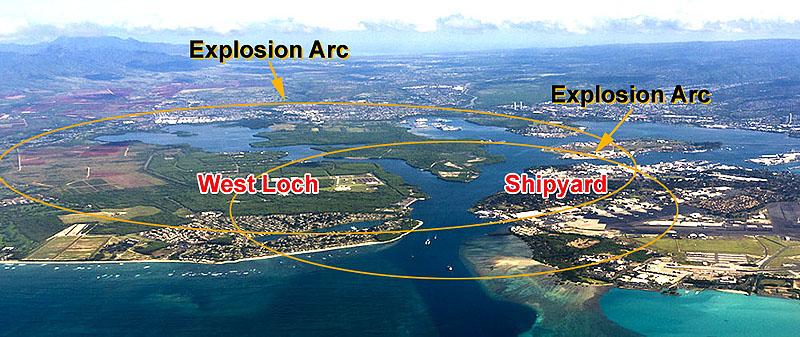
Environmental Impact Statement (EIS) Dry Dock Replacement And Waterfront Production Facility. Major Expansion of West Loch Depot Endangers Pearl Harbor-Hickam

  JOHN M. BOND KANEHILI HUI REPORT AND TESTIMONY Environmental Impact Statement (EIS) Dry Dock Replacement And Waterfront Production Facilit...