Search This Blog

Showing posts with label SSBN. Show all posts

Naval Submarine Base Bangor – Where The SSBN’s Are

 History Compiled by Ewa Historian John Bond


Naval Submarine Base Bangor – Where The SSBN’s Are

Everything shown here is from public government sources and not classified.

Almost everyone there knows about it. 

Naval Submarine Base Bangor is a former submarine base of the United States Navy that was merged with Naval Station Bremerton into Naval Base Kitsap in 2004. Naval Base Kitsap includes the Strategic Weapons Facility Pacific (SWFPAC) which provides maintenance, calibration, missile assembly/test, spare parts, and spare nuclear warhead storage for the UGM-133 Trident II submarine-launched ballistic missiles carried by the nuclear submarines.

This Trident submarine base is the sole one for the U.S. Pacific Fleet, with the Trident submarine base at Kings Bay, Georgia, for the U.S. Atlantic Fleet being the only other one.

This is the maintenance facility to service the Navy “boomer” missile submarines

https://en.wikipedia.org/wiki/Naval_Submarine_Base_Bangor

Commissioned as POLARIS Missile Facility Pacific (POMFPAC) in 1964, the POLARIS A3 missile facility was in full production and providing the Fleet with high-quality missiles by December of that year. Strategic Weapons Facility Pacific (SWFPAC) provides assembly, storage, checkout, onload and offload of Trident missiles; ensures custody, accountability and control of nuclear weapons and material; publishes and maintains START procedures and conducts START inspections; and provides technical engineering services for guidance, missile, and launcher support equipment.

This is a “special weapons” hangar facility to service the missiles of the Navy missile submarines

The Marine Corps Security Forces Battalion Bangor has secured the ballistic missile submarines and associated infrastructure since before it was specifically designated a security unit, at company size, in October 1978.

https://www.globalsecurity.org/wmd/facility/bangor.htm

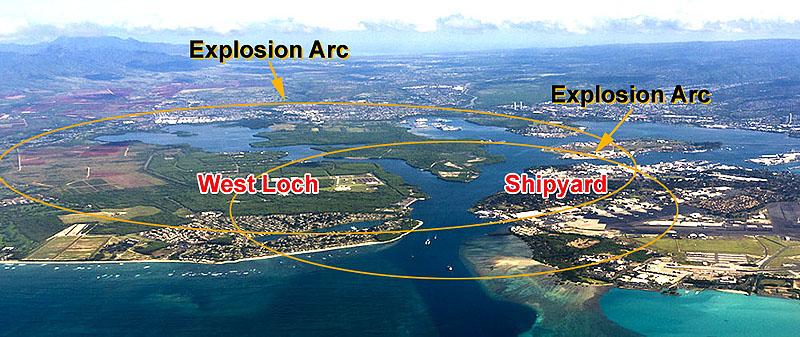
Navy plans called for the POLARIS FBM submarines to be operating in the Pacific. DoD announced, on 23 April 1962, the selection of various POLARIS support facilities in the Pacific and Puget Sound Naval Shipyard at Bremerton, Washington, was selected as the FBM submarine overhaul facility; the Naval Ammunition Depot at Bangor, Washington, was selected for the POLARIS missile assembly facility; Pearl Harbor, Hawaii, was chosen as the location of the crew training facility at West Loch Naval Ammunition Depot.

The primary high secure double fenced special weapons storage area is in the center of the image


Construction of the $12.5 million facility at Bangor began in March 1963. On 1 September 1963, the missile assembly facility was established in a development status and on 11 September 1964, POLARIS Missile Facility, Pacific (POMFPAC) was commissioned at the Naval Ammunition Depot, Bangor, Washington.


These are some of ammunition magazines that are not behind double fencing

Bangor is located on the Kitsap Peninsula on the shores of Hood Canal. The base included 7,676 acres of land, 5,000 of which are wooded. Bangor is the natural home for numerous wildlife. The Olympic Mountains provide a scenic backdrop for the base.

https://www.navsea.navy.mil/Home/TRFB/ The Delta Pier at Bangor, so named because of its triangular configuration, can support five SSBNs at one time. It has one of the largest drydocks built by the Navy and is the only drydock in the world constructed parallel to the shoreline.

Navy Builds Underground Nuclear Weapons Storage Facility; Seattle Busses Carry Warning

https://fas.org/blogs/security/2016/06/pacific-ssbn-base/

The US Navy has quietly built a new $294 million underground nuclear weapons storage complex at the Strategic Weapons Facility Pacific (SWFPAC), a high-security base in Washington that stores and maintains the Trident II ballistic missiles and their nuclear warheads for the strategic submarine fleet operating in the Pacific Ocean.

The SWFPAC and the eight Ohio-class nuclear-powered ballistic missile submarines (SSBNs) homeported at the adjacent Bangor Submarine Base are located only 20 miles (32 kilometers) from downtown Seattle. The SWFPAC and submarines are thought to store more than 1,300 nuclear warheads with a combined explosive power equivalent to more than 14,000 Hiroshima bombs.

A similar base with six SSBNs is located at Kings Bay in Georgia on the US east coast, which houses the SWFLANT (Strategic Weapons Facility Atlantic) that appears to have a dirt-covered warhead storage facility instead of the underground complex built at SWFPAC. Of the 14 SSBNs in the US strategic submarine fleet, 12 are considered operational with 288 ballistic missiles capable of carrying 2,300 warheads. Normally 8-10 SSBNs are loaded with missiles carrying approximately 1,000 warheads.

To bring public attention to the close proximity of the largest operational nuclear stockpile in the United States, the local peace group Ground Zero Center for Nonviolent Action has bought advertisement space on 14 transit buses. The busses will carry the posters for the next eight weeks. FAS is honored to have assisted the group with information for its campaign.

The US Navy describes the complex as “a reinforced concrete, underground, multi-level re-entry body processing and storage facility” with “hardened floors, and hardened load-bearing walls and roof.” Glen Milner at the Ground Zero Center helped locate some of the budget documents. Other construction details provided by the navy further describe the complex as:

A 16,000-m2 [180,000 square feet] multi-level, underground, hardened, blast-resistant, reinforced concrete structure, with approximate dimensions of 110 meters long by 82 meters wide. Two tunnels (approximately 122 meters long, 6 meters wide, and 6 meters tall) will provide heavy vehicle access to and from the LAPSC. An aboveground portion of the facility will provide administrative and utility support spaces. Special features of the facility include: power-operated physical security and blast-resistant doors, TEMPEST shielded rooms, seven (7) overhead bridge cranes (2 ton capacity), three (3) elevators, lightning protection system, grounding system, liquid waste collection/retention system, emergency air purge system, fire protection systems, and multiple HVAC systems. This project will also provide a new 1000 kW emergency generator (enclosed within a new hardened, reinforced concrete structure), two security guard towers, lightning protection, utilities, and other site improvements. The existing Limited Area perimeter fence, security zone, and patrol roads will be expanded to encompass the new LAPSC.


Naval Submarine Base Kings Bay – Where The SSBN’s Are

 History Compiled by Ewa Historian John Bond


Naval Submarine Base Kings Bay – Where The SSBN’s Are


Everything shown here is from public government sources and not classified.

 In fact everyone there knows about it.


https://en.wikipedia.org/wiki/Naval_Submarine_Base_Kings_Bay


Naval Submarine Base Kings Bay is a Navy base located adjacent to the city of St. Marys in Camden County, Georgia, on the North River in southeastern Georgia, and 38 miles from Jacksonville, Florida. The submarine base is the U.S. Atlantic Fleet's home port for U.S. Navy Fleet ballistic missile nuclear submarines capable of being armed with Trident missile nuclear weapons. The base covers about 16,000 acres of land, of which 4,000 acres are protected wetlands.


Above are missile loading hangars and in the background is the maintenance facility for the SSBN’s


A former Army base—Kings Bay was a former Army cargo terminal. The decision to base the Trident submarines at Kings Bay started the largest peacetime construction program ever undertaken by the Navy, taking nine years to complete at a cost of about $1.3 billion. The building project included the construction of three major commands: Trident Training Facility (TTF), Trident Refit Facility (TRF), and Strategic Weapons Facility, Atlantic (SWFLANT).


The double fenced area at bottom left is the “special weapons” storage area for the SSBN’s missiles


Post Cold-War Era


The end of the Cold War and the reorganization of Naval and Air Force strategic weapons forces during the 1990s had a significant effect on the submarine base at Kings Bay. A high-level nuclear weapons policy review recommended that the Navy reduce its number of Trident Fleet Ballistic Missile submarines from 18 to 14 by 2005.


The decision was made to temporarily decommission the four oldest Ohio-class Trident missile submarines for extensive shipyard work, in order to convert them into guided-missile submarines (SSGNs) carrying large numbers (about 150) of conventionally armed Tomahawk cruise missiles. These converted submarines also have accommodations for significant numbers of Navy SEALs or Marines

For covert operations.


Several Trident submarines were transferred from the Atlantic Fleet to the Pacific Fleet. USS Pennsylvania departed on 4 August 2003 and USS Kentucky departed on 24 August 2003, bound for the Trident submarine base at Bangor, Washington as part of balancing the Trident fleet. In addition, both USS Louisiana and USS Maine were transferred to the Pacific Fleet in 2005.


Marine Corps Security Force Battalion, Kings Bay conducts security operations in support of Strategic Weapons Facility, Atlantic (SWFLANT.) The battalion is commanded by a senior Marine Corps officer and provides security operations as approved by the Chief of Naval Operations. As of June 27, 2008, MCSFCO was restructured from a company to a battalion. A similar sister battalion is stationed with the West Coast submarine base in Bangor, Washington.


Navy awards contract for Kings Bay dry dock work

March 26, 2020

https://www.fbnewsleader.com/regional/navy-awards-contract-kings-bay-dry-dock-work


The Navy awarded its first contract this week for what could be close to $1 billion dollars in improvements to accommodate Columbia class submarines at Kings Bay Naval Submarine Base. 


Kings Bay is currently homeport to both guided-missile and ballistic-missile Ohio class submarines and will be the homeport for half of the Navy’s new class of strategic deterrent submarines. Kings Bay won’t receive its first Columbia class submarine for several years but major repairs are needed and facilities need to be built so sailors and civilians can work on both types of submarines during the transition. Estimated to cost roughly $841 million, projects include updating and constructing training and maintenance buildings, increasing pier space and doing major repairs on the covered dry dock. 


 The Navy’s Facilities Engineering Command Southeast (NAVFAC) has set up an office at Kings Bay to manage the project.


15 Facts About Kings Bay You Probably Didn’t Know


https://nuclearcompanion.com/15-facts-about-naval-submarine-base-kings-bay-you-probably-didnt-know/


Has the Deepest Covered Dry Dock in the Whole Western Hemisphere. The Trident covered dry dock stands as the deepest in the western hemisphere thanks to its 67 ft. of depth.


Regarding the dock’s dimensions, its 700 ft. long and 100 ft. wide. To fill its enormous base, with a capacity of 33 million gallons of water, the contractor had to build a concrete plant on site. This immense body of water can be pumped out for repairing a submarine, leaving it standing on blocks.  


Trident submarines are big, measuring 580 feet and weighing 18,000 tons, twice as much as a World War II heavy cruiser. So the low depth of the water forced the US Navy to consider a special channel for them to reach the base.  Submarines needed a depth of at least 50 ft. 


Sub missiles are assembled locally with around 55,000 components from 1,800 suppliers from all the US. Kings Bay has the capacity to assembly its very own missiles for its Trident submarines. In charge of this task is the “Strategic Weapons Facility, Atlantic” (SWFLANT).


Located at the center of the base, the facility’s complex covers 800 acres. Clearly, this particular location is not arbitrary at all. This disposition responds to reducing damage in case of an explosion in the facility. That’s why 70 ft. earthen mounds flank it.


For piecing together the missiles, the facility gets the pieces directly from the manufactures. A lot of manufacturers. In fact, more than 1,800 suppliers have their pieces sent to the base. Rail cars and guarded convoys deliver all parts to the facility. There, Lockheed Martin Missiles and Space Co. is in charge of the assembly.


It has a whole Marine Company securing the base. Throughout its 16,000 acres, the base maintains rigorous security measures. Both land and sea are under constant surveillance. To cover this perimeter, the US Navy uses interlocking chain fences as well as patrol dogs. Watchtowers surround it while its own Marine Corps guard of 300 soldiers sentinel the area. Also, each of these buildings has double rows of chain-link fence.


The Strategic Weapons Facility, for its part, forms an even stricter perimeter. Inside its perimeter are the assembly buildings, as well as seventy magazines for the storage of warheads, rocket fuel, and motors.


Unlike Bangor, both humidity and temperature are significant concerns in southeast Georgia for HVAC systems.


Strict controls are also kept when translating the missiles to the submarines. Reinforced roadbeds move the missiles in canisters from the buildings to the submarines. In this slow process, the missiles go first to a covered wharf. There, the canisters are lifted vertically over the empty tubes where the missiles lower into their place.


Kings Bay’s submarines have to make a very long trip to get into deep water. As far as a hundred miles offshore, to be precise. That is until leaving the continental shelf itself. Before departing submarines have only around 60 ft of depth to navigate. Therefore, they are unable to fully dive and disappear into the water without making a large journey offshore first.

A whole different deal in comparison with the Pacific Navy base of Bangor, Washington. In the west coast of the US, that same continental shelf vanishes shortly after the coast. As a result, submarines can quickly dive into the ocean after leaving Puget Sound.


Submarine Missiles Are Not Armed While in the Base. Only after passing Cumberland Island Sound the crew connects the missiles to their ignition system. This system consists of a converter from DC to AC which delivers an electric charge of 2,800 volts. This electric charge ignites the Westinghouse steam generator which propels the under-pressurized-steam missiles. These electrical devices are the key part of launching. As such, they are kept apart when near the base to avoid any accidental launching.  


SWFLANT, King's Bay, Georgia

https://www.globalsecurity.org/wmd/facility/kings_bay.htm


Environmental Impact Statement (EIS) Dry Dock Replacement And Waterfront Production Facility. Major Expansion of West Loch Depot Endangers Pearl Harbor-Hickam

  JOHN M. BOND KANEHILI HUI REPORT AND TESTIMONY Environmental Impact Statement (EIS) Dry Dock Replacement And Waterfront Production Facilit...