Search This Blog

Showing posts with label Pearl Harbor Explosion. Show all posts

Naval Weapons Station Earle

 Compiled by Ewa Historian John Bond

Naval Weapons Station Earle

https://en.wikipedia.org/wiki/Naval_Weapons_Station_Earle

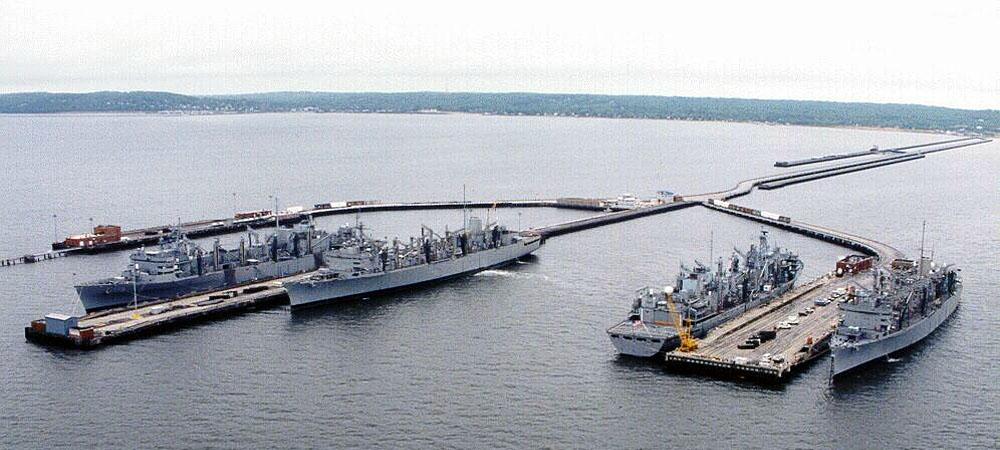
Naval Weapons Station Earle is a United States Navy base in Monmouth County, New Jersey, United States. Its distinguishing feature is a 2.9-mile (4.7 km) pier in Sandy Hook Bay where ammunition can be loaded and unloaded from warships at a safe distance from heavily populated areas.

The station's Pier Complex is one of the longest "finger piers" in the world. It is presently comprised of a two mile long trestle which connects to three finger piers - which are Piers 2, 3, and 4. These piers stretch nearly three miles into the Sandy Hook Bay. One mile from the shore the trestle branches off to Pier 1. At the junction of Piers 2, 3, and 4, a concrete platform exits which supports a forklift/battery recharging shop and the port operations building. This area is known as the "wye". All of the existing structures, with the exception of Pier 4 and the "wye", were constructed in the early 1940s. The "wye" was constructed in 1981 and Pier 4 was completed in 1990.

Naval Weapons Station Earle

https://www.globalsecurity.org/military/facility/earle.htm

The Earle Naval Weapons Station, Earle/Leonardo Pier complex, is located along the northern New Jersey shore in the south end of Sandy Hook Bay. It is located 4 miles west of Sandy Hook and 7 miles southeast of Staten Island. The command's name was changed in 1974 from Naval Ammunition Depot to Naval Weapons Station.

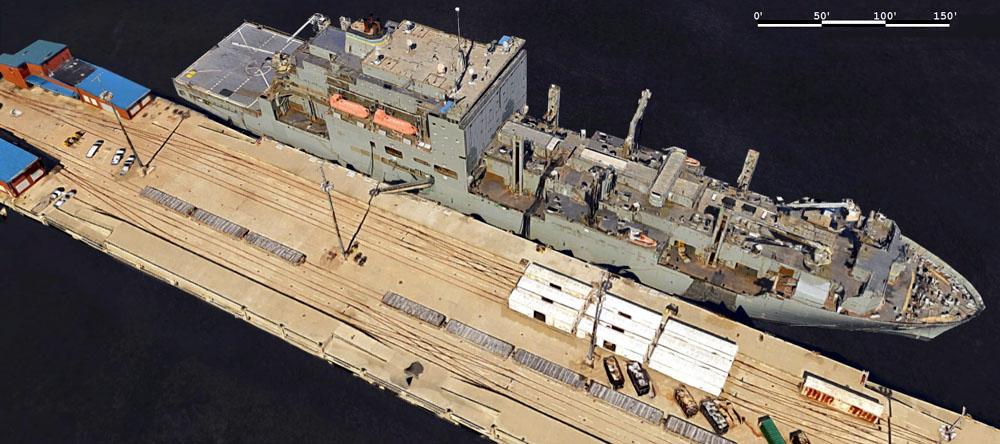
The waterfront complex is the homeport to USS Seattle (AOE 3), USS Detroit (AOE 4), USS Supply (AOE 6), USS Arctic (AOE 8), and Combat Logistics Group 2. Effective June 1, 1997 the USS Supply moved to Earle. Earle provides logistical, technical and material support to the fleet in a variety of areas ranging from combat subsystems and retail ammunition management to ordnance packaging, handling and storage.

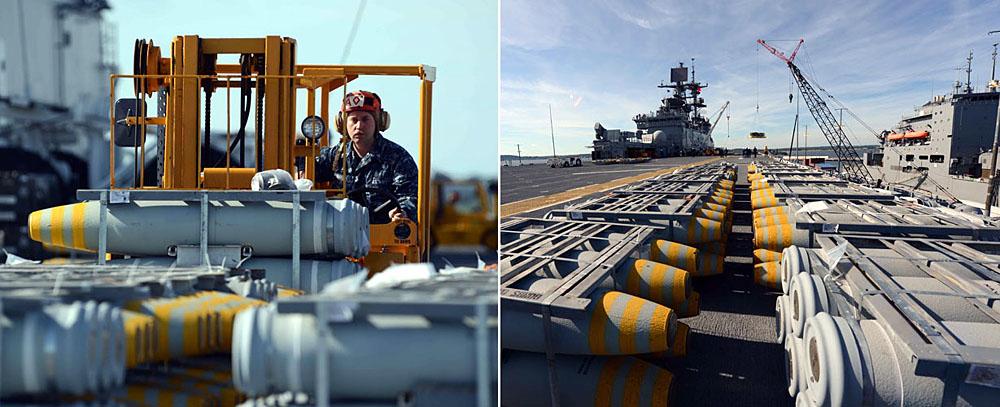
Since Earle is a weapons station, it handles, stores, transports, renovates and issues all types of weapons and ammunition. The USS Arctic moved in June 1998. As a result of these decisions, the use of this important facility greatly increased. The Congress noted in 1996 that a parking facility for 60 ordnance loaded trucks is the minimum needed for loading an AOE class ship. Both of the ships subsequently moved to Earle are AOE class ships.

Construction was needed to make the facilities at Earle safer and more efficient through the construction of an Explosive Truck Holding Yards along the waterfront and main side parking facilities. This project (P-245) was originally included in the FY 1994 appropriations bill. in 1996 year the Appropriations Committee included language in its bill that approved a reprogramming request and indicated its support for the construction of these holding yards. Despite the growth of Earle's mission and the support from the Appropriations Committee, this project kept getting pushed back. The Navy budgeted this for FY 1999.

Naval Ammunition Depot Earle commissioned on December 13, 1943

The station - named after RADM Ralph Earle, has two distinct areas. A waterfront location provided ships with a safe and operationally advantageous port to take on ammunition, while an inland storage area, safe from possible submarine bombardment, provided access to commercial rail facilities with lines coming from the west, where the majority of ammunition shipments originated. On August 2, 1943, construction began and in a short time, storage bunkers, a road and rail network, numerous buildings, and a pier complex were built. Named after Rear Admiral Ralph Earle, Chief of the Bureau of Ordnance during World War I, the Station was commissioned on December 13, 1943 as the Naval Ammunition Depot Earle. Earle continued to develop after World War II, keeping pace with the changing needs of the Navy.

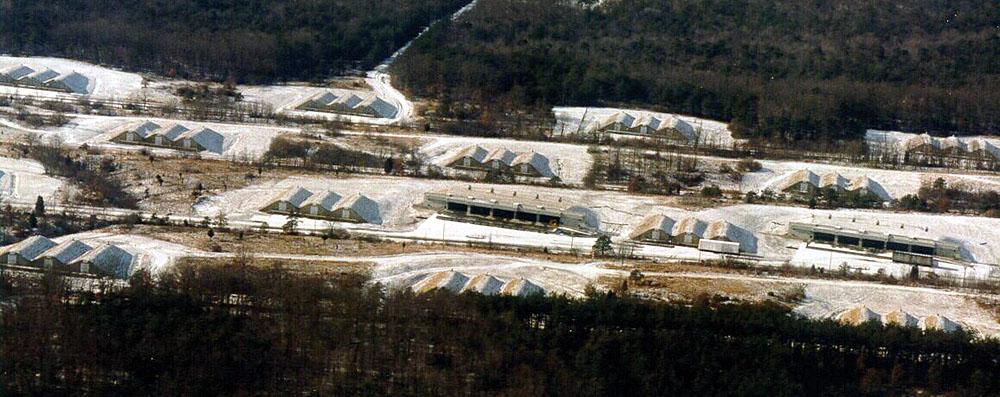
Munitions Magazines At Earle Include Both Older "Igloo" And Newer Type D Missile Magazines

The Sandy Hook Channel entrance leads to Terminal Channel and Earle/Leonardo Pier. Terminal Channel, entered from Sandy Hook Channel about 1 mile west-southwest of the northern tip of Sandy Hook, leads to a turning basin, and two deep water ammunition handling piers of the U. S. Naval Ammunition Depot at Earle/Leonardo. Federal project depth is 35 feet in the channel and turning basin. The deep water piers and barge pier are connected to the shore by a trestle that extends nearly two miles across the mud flats from Earle/Leonardo.

The pier stretches 2.2 miles into the Sandy Hook bay and comprises 2.9 miles of pier/trestle surface area. The Station is divided into two sections: Main-side, located in Colts Neck, and the Waterfront Area, on Sandy Hook Bay, located in the Leonardo section of Middletown. Both areas are connected by Normandy road, a 15-mile military road and rail line.

Trestle 1 is the 2 mile long rail and road causeway that leads to Trestles 2, 3 and 4. There are no docking or berthing facilities on Trestle 1.

Trestle 2 leads to Pier 2, and berths 2N1 on the west side and 2N2 on the east side. Berth lengths on Pier 2 are 600 feet with a 500 feet long elevated loading platform on each side of the pier. Pier deck height is 13 feet above MLW, loading platform height is 18 feet above MLW, and the alongside depth is 35 feet at MLW. Pier 2 is not currently used for cargo loading.

Trestle 3 leads to Pier 3 and berths 3A3 and 3A1 (west side), and 3A4 and 3A2 (east side). Total berth length is 1200 feet long with two 500 feet elevated loading platforms on each side of the pier. Pier deck height is 12 feet above MLW, loading platform height is 17 feet above MLW, and the alongside depth is 35 feet at MLW. A small boat mooring area is located in the southeast end of Trestle 3. Tugs and yard craft are moored in this location.

Trestle 4 leads to Pier 4 and berths 4W (west side) and 4E (east side). Berth length is 800 ft with a 600 ft long elevated loading platform on each side of the pier. Pier deck height is 13 feet above MLW, loading platform height is 18 feet above MLW, and the alongside depth is 45 feet at MLW. Pier 4 is the primary cargo-loading pier. A project to improve fendering on Pier 4 was completed by 2001.

The Main side area, which is located mainly in Colts Neck, is more than 10,000 acres which contains ordnance storage areas and the majority of Earle's departments and facilities. Main side is in many ways like a small town with its own police and fire departments, homes, office buildings, restaurants, and recreational facilities.


Long Forgotten Ammunition Ships USS Mount Hood, USS Serpens Explosions

 Compilations by Ewa Historian John Bond

Long Forgotten Ammunition Ships USS Mount Hood, USS Serpens Explosions

https://en.wikipedia.org/wiki/USS_Mount_Hood_(AE-11)

No human remains were recovered of the 350 men aboard Mount Hood or small boats loading alongside at the time of the explosion. The concussion and metal fragments hurled from the ship caused casualties and damage to other ships and small craft within 2,000 yards (6000 feet.)

Examined evidence relating to the disaster was unable to ascertain the exact cause

USS Mount Hood (AE-11) was the lead ship of her class of ammunition ships for the United States Navy in World War II. She was the first ship named after Mount Hood, a volcano in the Cascade Range in Oregon. On 10 November 1944, shortly after 18 men had departed for shore leave, the rest of the crew were killed when the ship exploded in Seeadler Harbor at Manus Island in Papua New Guinea. The ship was obliterated while also sinking or severely damaging 22 smaller craft nearby.

Mount Hood, anchored in about 35 ft (11 m) of water,[1] had exploded with an estimated 3,800 long tons (3,900 t) of ordnance material on board. The initial explosion caused flame and smoke to shoot up from amidships to more than masthead height. Within seconds, the bulk of her cargo detonated with a more intense explosion. Mushrooming smoke rose to 7,000 ft (2,100 m), obscuring the ship and the surrounding area for a radius of approximately 500 yd (460 m). Mount Hood's former position was revealed by a trench in the ocean floor 1,000 ft (300 m) long, 200 ft (61 m) wide, and 30–40 ft (9–12 m) deep.[1] The largest remaining piece of the hull was found in the trench and measured no bigger than 16 by 10 ft (5 by 3 m). No other remains of Mount Hood were found except fragments of metal which had struck other ships in the harbor and a few tattered pages of a signal notebook found floating in the water several hundred yards away. No human remains were recovered of the 350 men aboard Mount Hood or small boats loading alongside at the time of the explosion. 

The concussion and metal fragments hurled from the ship caused casualties and damage to other ships and small craft within 2,000 yd (6000 feet ). The repair ship Mindanao, which was broadside-on to the blast, was the most seriously damaged. All personnel topside on Mindanao were killed outright, and dozens of men were killed or wounded below decks as numerous heavy fragments from Mount Hood penetrated the side plating. Eighty-two of Mindanao's crew died.[1] 22 small boats and landing craft were sunk, destroyed, or damaged beyond repair, while damage to other vessels required more than 100,000 man-hours to repair; a further 371 sailors from ships in the harbor were injured.


A board convened to examine evidence relating to the disaster was unable to ascertain the exact cause. After only a little over four months' service, Mount Hood was struck from the Naval Register on 11 December 1944.


Largest US Coast Guard Disaster Ship Explosion Disaster, 

29 January 1945

https://en.wikipedia.org/wiki/USS_Serpens_(AK-97)

196 crewmen, 57 Army stevedores and a soldier ashore was killed by shrapnel. The cause of the explosion could not be established but was likely due to the loading process.

Late in December 1944, the Liberty ship commenced loading at Wellington, finished it at Auckland, and returned to the Solomons in mid-January 1945. Late in the evening on 29 January 1945, Serpens was anchored off Lunga Beach.[3] The commanding officer and seven others, one officer and six enlisted men, were ashore. The remaining crewmen were loading depth charges into her holds when Serpens exploded. 

After the explosion, only the bow of the ship was visible. The rest had disintegrated, and the bow sank soon afterward. One hundred ninety-six Coast Guard crewmen, 57 Army stevedores, and a Public Health Service physician, Dr. Harry M. Levin, were killed in the explosion, and a soldier ashore was killed by shrapnel. Only two of those on board, Seaman (SN) 1/c Kelsie K. Kemp and SN 1/c George S. Kennedy, who had been in the boatswain's locker, survived. 

An eyewitness to the disaster stated: "As we headed our personnel boat shoreward the sound and concussion of the explosion suddenly reached us, and, as we turned, we witnessed the awe-inspiring death drama unfold before us. As the report of screeching shells filled the air and the flash of tracers continued, the water splashed throughout the harbor as the shells hit. We headed our boat in the direction of the smoke and as we came into closer view of what had once been a ship, the water was filled only with floating debris, dead fish, torn life jackets, lumber and other unidentifiable objects. The smell of death, and fire, and gasoline, and oil was evident and nauseating. This was sudden death, and horror, unwanted and unasked for, but complete." 

Lieutenant Commander Stinson reported: "I felt and saw two flashes after which only the bow of the ship was visible. The rest had disintegrated and the bow sank soon afterwards." The two survivors, SN 1/c Kemp and SN 1/c Kennedy, according to Stinson, ". . .showed a lot of savvy by grabbing a couple of water lights that we kept stowed in the [boatswain's] locker. They used them to attract attention when they climbed out onto the floating portion of the bow." Both men were injured but were rescued by a base commander in the area. 

At first report the incident was attributed to enemy action but a court of inquiry later determined that the cause of the explosion could not be established from the remaining evidence and by 1949, the Navy noted that the loss was not due to enemy action but due to an "accident intrinsic to the loading process." 


Other Huge Explosions Largely Forgotten Today

Black Tom

The New York harbor explosion was heard as far away as Maryland and Connecticut

Early in the morning of July 30, 1916, German agents, probably assisted by Irish nationalists, blew up a munitions dump at the Black Tom railroad yard and the adjoining warehouses in New York harbor. By the beginning of the twentieth century, Black Tom was serving as a major munitions depot. German agents who were determined to prevent American munitions shippers from supplying its English enemy during the First World War. Never mind that the U.S. was officially neutral in the conflict at this point. A million people, maybe five millions, were awakened by the explosion that shook the houses along the marshy New Jersey shores, rattled the skyscrapers on the rock foundation of Manhattan, threw people from their beds miles away and sent terror broadcast. 

The noise of the explosion was heard as far away as Maryland and Connecticut. Pieces of metal damaged the skirt of the Statue of Liberty (it is because of this explosion that the Lady's torch has been closed off to visitors. It was a stunning event, in both magnitude and consequence. Sabotage became a national issue. Congress immediately passed the Espionage Act, which outlawed a variety of crimes associated with German agents. The site is now Liberty State Park, where tourist boats depart to visit the Statue of Liberty.

Halifax

The explosion destroyed 3,000 dwellings, killed more than 1,600 people and injured 9,000. Most of the dead were children

On the morning of Dec. 6, 1917, a tremendous blast ripped through the sleepy town of Halifax, Nova Scotia. The explosion destroyed 3,000 dwellings, killed more than 1,600 people and injured 9,000. Most of the dead were children. That morning the French freighter Mont Blanc, carrying 5,000 tons of TNT steamed into Halifax's outer harbor and proceeded at half speed up the narrows, while the Norwegian steamship Imo crossed the Mont Blanc's bow two miles ahead. As the two ships approached, there was great confusion regarding which ship had the right of way. The Imo reversed engines, but being in ballast, swung so that the bow pointed directly at the Mont Blanc. A collision was now inevitable. The Mont Blanc's captain attempted to minimize the potential of his cargo exploding by maneuvering his ship so that the forward hold, containing no TNT, would be struck.


1969 Near Hawaii - The ammunition cargo ship sank with the loss of 5336 long tons of munitions

https://www.history.navy.mil/about-us/leadership/director/directors-corner/h-grams/h-gram-041/h-041-5.html

Eventually, the fire spread and more munitions exploded. The ship sank on 5 January 1970. In this incident, there were only fourteen survivors out of the crew of forty men.

On 26 December 1969 the Vietnam-bound ammunition ship SS Badger State, carrying 8,900 bombs and rockets equal to 2,000 tons of TNT. Soon after departure, the ship’s steering system began leaking hydraulic fluid, compromising the operation of the rudder. Heavy weather in the North Pacific rocked the ship, causing her to roll repeatedly more than 50 degrees. 

During the storm, some of the dunnage securing the cargo broke loose and bomb pallets came apart. Because of the heavy seas, the crewmen were unable to restrain the bombs from rolling around in the hole of the ship. Finally, one of the bombs exploded. It blew a hole in the starboard side of the ship and started a fire, then was rocked by explosions and abandoned by her crew in rough seas 1,500 miles northeast of Hawaii. The next day 14 crewmen were picked up by a Greek ship, the Khian Star, and a US Air Force HC-130 rescue plane dropped life rafts and dye marker at the site. Rescue planes and ships found no sign of the 26 missing men, some of whom were last seen clinging to life rafts in 20 foot seas.

The ammunition cargo ship sank with the loss of 5336 long tons of munitions destined for Vietnam. The ship was fully loaded, mostly, with MK-82 (500 lbs), M117 (750 lbs), and MK-84 (2000 lbs) bombs. These bombs were loaded, respectively, with H-6 (TNT/RDX/aluminum/wax), Tritonal (TNT/aluminum), or Minol 2 (TNT/ammonium nitrate/aluminum) explosive compositions.

When it became obvious that the fires could not be controlled, the Captain ordered that the vessel abandoned and lifeboats were launched. As one of the lifeboats drifted in the water near the starboard side of the ship, a 2000-pound bomb fell out of the hole that had been blown open by the bomb explosion. It capsized the lifeboat and threw the men into the water.

Eventually, the fire spread and more munitions exploded. The ship sank on 5 January 1970. In this incident, there were only fourteen survivors out of the crew of forty men. The cost of the ship and the cargo lost was in millions of dollars.

US government investigators who inquired into the explosion on the SS Badger State criticized the procedure used to stow bombs on board. Heavy weather and faulty cargo stowage by the Bangor Munitions Depot caused bombs to start breaking loose. The crew fought for 9 days to steady the cargo and several times changed the course in attempts to find calm seas. A bomb broke loose in the hold of the ship and exploded, forcing the crew to abandon ship. The Navy abandoned plans to salvage the deserted and burning ship. On 01 January 1970, and the vessel sank.

Those Badger State mariners were likely not comforted when they remembered advice published in the May 1968 issue of Sealift, the official publication of MSTS:

Ordnance experts and others knowledgeable about such matters as unarmed bombs, will be quick to reassure the laymen that there is little to fear from a bomb or projectile as long as there is no detonator attached. But, despite all the evidence that it is virtually impossible to explode one, that an unarmed 1,000-pound bomb is about as lethal as 1,000 pounds of cabbage, it is nevertheless nerve-racking to be riding a ship with even one such bomb adrift in a cargo hold.

The 1944 Port Chicago Explosion Disaster Was Caused By The Ship Loading Process

Loaders, who had no training, were constantly encouraged to increase their speed and quotas.

https://www.history.com/this-day-in-history/port-chicago-disaster

On the evening of July 17, the SS Quinault Victory and SS E.A. Bryan, two merchant ships, were being loaded. The holds were being packed with 4,600 tons of explosives–bombs, depth charges and ammunition. Another 400 tons of explosives were nearby on rail cars. Approximately 320 workers were on or near the pier when, at 10:18 p.m., a series of massive explosions over several seconds destroyed everything and everyone in the vicinity. The blasts were felt as far away as Nevada and the resulting damage extended as far as San Francisco. Every building in Port Chicago was damaged and people were literally knocked off their feet. Smoke and fire extended nearly two miles into the air. The pilot of a plane flying at 9,000 feet in the area claimed that metal chunks from the explosion flew past him.

Naval Submarine Base Kings Bay – Where The SSBN’s Are

 History Compiled by Ewa Historian John Bond


Naval Submarine Base Kings Bay – Where The SSBN’s Are


Everything shown here is from public government sources and not classified.

 In fact everyone there knows about it.


https://en.wikipedia.org/wiki/Naval_Submarine_Base_Kings_Bay


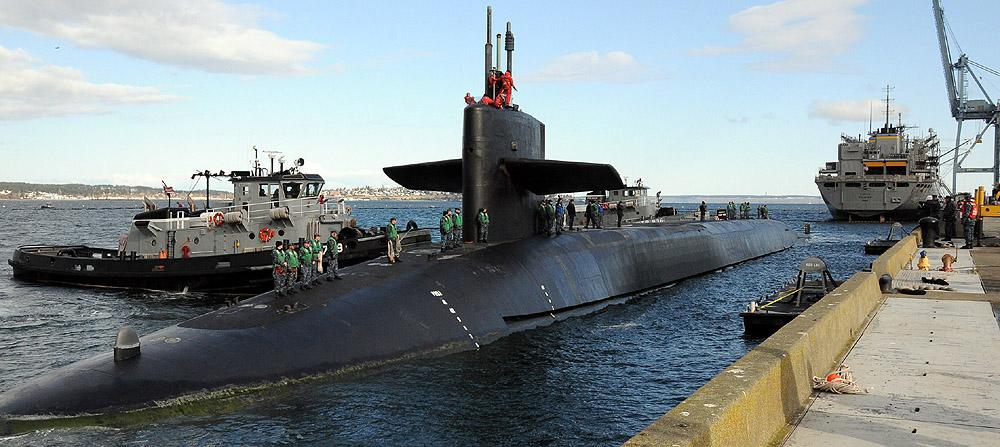
Naval Submarine Base Kings Bay is a Navy base located adjacent to the city of St. Marys in Camden County, Georgia, on the North River in southeastern Georgia, and 38 miles from Jacksonville, Florida. The submarine base is the U.S. Atlantic Fleet's home port for U.S. Navy Fleet ballistic missile nuclear submarines capable of being armed with Trident missile nuclear weapons. The base covers about 16,000 acres of land, of which 4,000 acres are protected wetlands.


Above are missile loading hangars and in the background is the maintenance facility for the SSBN’s


A former Army base—Kings Bay was a former Army cargo terminal. The decision to base the Trident submarines at Kings Bay started the largest peacetime construction program ever undertaken by the Navy, taking nine years to complete at a cost of about $1.3 billion. The building project included the construction of three major commands: Trident Training Facility (TTF), Trident Refit Facility (TRF), and Strategic Weapons Facility, Atlantic (SWFLANT).


The double fenced area at bottom left is the “special weapons” storage area for the SSBN’s missiles


Post Cold-War Era


The end of the Cold War and the reorganization of Naval and Air Force strategic weapons forces during the 1990s had a significant effect on the submarine base at Kings Bay. A high-level nuclear weapons policy review recommended that the Navy reduce its number of Trident Fleet Ballistic Missile submarines from 18 to 14 by 2005.


The decision was made to temporarily decommission the four oldest Ohio-class Trident missile submarines for extensive shipyard work, in order to convert them into guided-missile submarines (SSGNs) carrying large numbers (about 150) of conventionally armed Tomahawk cruise missiles. These converted submarines also have accommodations for significant numbers of Navy SEALs or Marines

For covert operations.


Several Trident submarines were transferred from the Atlantic Fleet to the Pacific Fleet. USS Pennsylvania departed on 4 August 2003 and USS Kentucky departed on 24 August 2003, bound for the Trident submarine base at Bangor, Washington as part of balancing the Trident fleet. In addition, both USS Louisiana and USS Maine were transferred to the Pacific Fleet in 2005.


Marine Corps Security Force Battalion, Kings Bay conducts security operations in support of Strategic Weapons Facility, Atlantic (SWFLANT.) The battalion is commanded by a senior Marine Corps officer and provides security operations as approved by the Chief of Naval Operations. As of June 27, 2008, MCSFCO was restructured from a company to a battalion. A similar sister battalion is stationed with the West Coast submarine base in Bangor, Washington.


Navy awards contract for Kings Bay dry dock work

March 26, 2020

https://www.fbnewsleader.com/regional/navy-awards-contract-kings-bay-dry-dock-work


The Navy awarded its first contract this week for what could be close to $1 billion dollars in improvements to accommodate Columbia class submarines at Kings Bay Naval Submarine Base. 


Kings Bay is currently homeport to both guided-missile and ballistic-missile Ohio class submarines and will be the homeport for half of the Navy’s new class of strategic deterrent submarines. Kings Bay won’t receive its first Columbia class submarine for several years but major repairs are needed and facilities need to be built so sailors and civilians can work on both types of submarines during the transition. Estimated to cost roughly $841 million, projects include updating and constructing training and maintenance buildings, increasing pier space and doing major repairs on the covered dry dock. 


 The Navy’s Facilities Engineering Command Southeast (NAVFAC) has set up an office at Kings Bay to manage the project.


15 Facts About Kings Bay You Probably Didn’t Know


https://nuclearcompanion.com/15-facts-about-naval-submarine-base-kings-bay-you-probably-didnt-know/


Has the Deepest Covered Dry Dock in the Whole Western Hemisphere. The Trident covered dry dock stands as the deepest in the western hemisphere thanks to its 67 ft. of depth.


Regarding the dock’s dimensions, its 700 ft. long and 100 ft. wide. To fill its enormous base, with a capacity of 33 million gallons of water, the contractor had to build a concrete plant on site. This immense body of water can be pumped out for repairing a submarine, leaving it standing on blocks.  


Trident submarines are big, measuring 580 feet and weighing 18,000 tons, twice as much as a World War II heavy cruiser. So the low depth of the water forced the US Navy to consider a special channel for them to reach the base.  Submarines needed a depth of at least 50 ft. 


Sub missiles are assembled locally with around 55,000 components from 1,800 suppliers from all the US. Kings Bay has the capacity to assembly its very own missiles for its Trident submarines. In charge of this task is the “Strategic Weapons Facility, Atlantic” (SWFLANT).


Located at the center of the base, the facility’s complex covers 800 acres. Clearly, this particular location is not arbitrary at all. This disposition responds to reducing damage in case of an explosion in the facility. That’s why 70 ft. earthen mounds flank it.


For piecing together the missiles, the facility gets the pieces directly from the manufactures. A lot of manufacturers. In fact, more than 1,800 suppliers have their pieces sent to the base. Rail cars and guarded convoys deliver all parts to the facility. There, Lockheed Martin Missiles and Space Co. is in charge of the assembly.


It has a whole Marine Company securing the base. Throughout its 16,000 acres, the base maintains rigorous security measures. Both land and sea are under constant surveillance. To cover this perimeter, the US Navy uses interlocking chain fences as well as patrol dogs. Watchtowers surround it while its own Marine Corps guard of 300 soldiers sentinel the area. Also, each of these buildings has double rows of chain-link fence.


The Strategic Weapons Facility, for its part, forms an even stricter perimeter. Inside its perimeter are the assembly buildings, as well as seventy magazines for the storage of warheads, rocket fuel, and motors.


Unlike Bangor, both humidity and temperature are significant concerns in southeast Georgia for HVAC systems.


Strict controls are also kept when translating the missiles to the submarines. Reinforced roadbeds move the missiles in canisters from the buildings to the submarines. In this slow process, the missiles go first to a covered wharf. There, the canisters are lifted vertically over the empty tubes where the missiles lower into their place.


Kings Bay’s submarines have to make a very long trip to get into deep water. As far as a hundred miles offshore, to be precise. That is until leaving the continental shelf itself. Before departing submarines have only around 60 ft of depth to navigate. Therefore, they are unable to fully dive and disappear into the water without making a large journey offshore first.

A whole different deal in comparison with the Pacific Navy base of Bangor, Washington. In the west coast of the US, that same continental shelf vanishes shortly after the coast. As a result, submarines can quickly dive into the ocean after leaving Puget Sound.


Submarine Missiles Are Not Armed While in the Base. Only after passing Cumberland Island Sound the crew connects the missiles to their ignition system. This system consists of a converter from DC to AC which delivers an electric charge of 2,800 volts. This electric charge ignites the Westinghouse steam generator which propels the under-pressurized-steam missiles. These electrical devices are the key part of launching. As such, they are kept apart when near the base to avoid any accidental launching.  


SWFLANT, King's Bay, Georgia

https://www.globalsecurity.org/wmd/facility/kings_bay.htm


Indian Island – The West Coast's major Navy ammunition site

 Compiled by Ewa Historian John Bond

Indian Island – The West Coast's major Navy ammunition site

https://www.globalsecurity.org/military/facility/indian-island.htm

Ammunition Depot Indian Island, Port Hadlock, Washington

https://www.kitsapsun.com/story/news/2017/11/26/little-known-island-logistics-backbone-pacific-northwest-navy-fleet/886272001/


A new command officially joined the four major US Navy installations of Navy Region Northwest during a brief ceremony 27 April 2000. The former Naval Weapons Station Seal Beach, Detachment Port Hadlock, officially became Naval Magazine Indian Island. The 2,716-acre facility now reports directly to the region commander rather than a series of others in the Southwest. The mission of providing ordnance-related support including receipt, storage, issuance, and inspection did not change, nor did the staffing of approximately 12 active duty members and 124 civil service and contract employees. Effective 01 October 1999, Naval Magazine [NAVMAG] Indian Island (formally known as Port Hadlock Weapons Detachment) had its support moved from the southwest region (Seal Beach) to the northwest region (Subase Bangor).


Ships at the Ammunition Pier are serviced by tugs from SUBASE Bangor for docking and undocking evolutions. The type of cargo that is loaded/offloaded is primarily ammunition (e.g., bombs, bullets and missiles). 


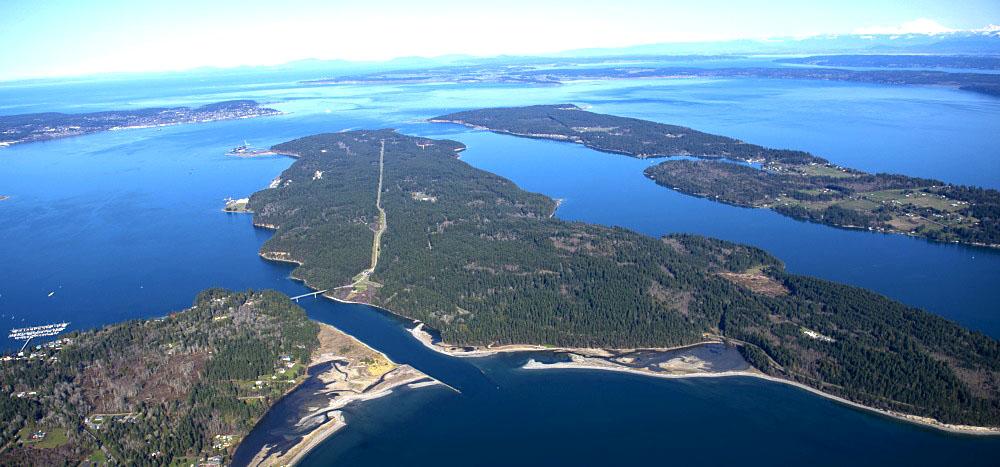
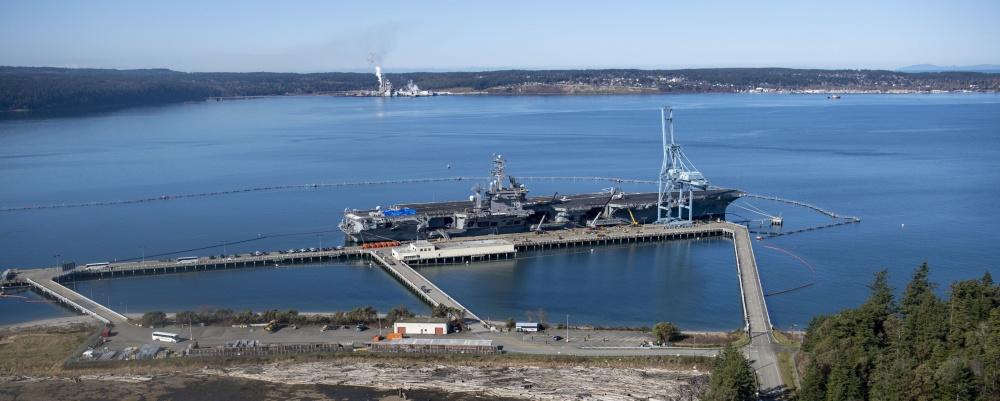
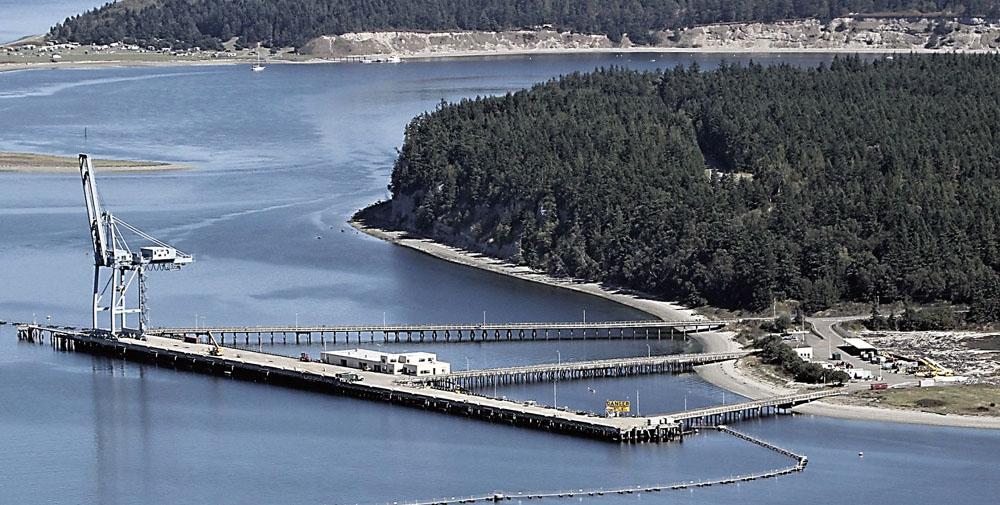
Indian Island is located west of Marrowstone Island between the waters of Port Townsend and Kilisut Harbor. Indian Island is approximately 4.2 nmi long and oriented on a north-south axis between Marrowstone Island and the mainland of the Quimper Peninsula. The Naval Ammunition Depot (NAD) is located on the northwest side of Indian Island.


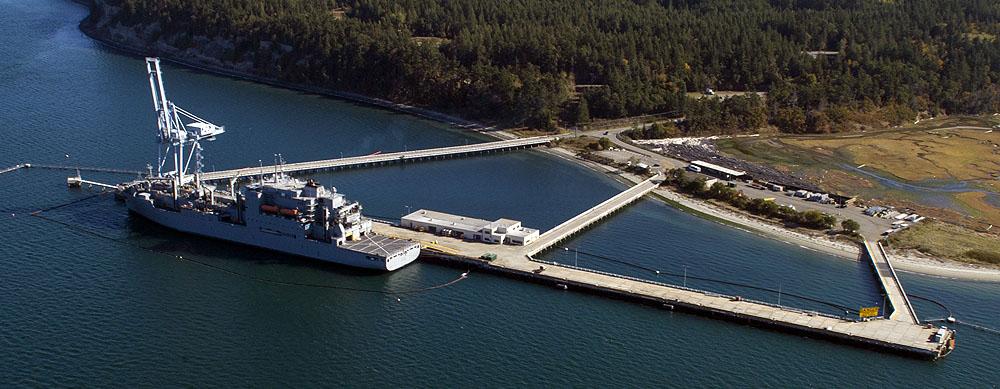
The Ammunition Pier is located on the extreme northwest part of the island at approximately The Ammunition Pier is the primary maritime facility of NAD Indian Island. It is large enough to accommodate a Nimitz class aircraft carrier (1,040 feet long/91,487 to 96,358 tons). The pier is 1,500 feet (457 m) long, not counting tug berths on mooring floats on the south end of the pier. According to harbor pilots at Bremerton, the wooden pilings used in the construction of the pier would not support an aircraft carrier in an on-setting wind, so steel pilings 600 feet apart were installed.


Because of the distance between the steel pilings, camels are now needed by moored ships to accommodate the pilings. A second, older pier is located on the west side of the island south of the ammunition pier, but a 200 feet section was lost in a severe wind storm. It has not been rebuilt and is now condemned. Alongside depths at the Ammunition Pier are 50 feet (15.2 m) or more. The depths increase rapidly away from the pier.


Because of its protected location on Port Townsend, wave motion is not a problem at the Ammunition Wharf. Waves in Admiralty Inlet just outside of Port Townsend can be a problem for inbound and outbound vessels during periods of strong northwesterly winds. Currents are not a significant problem at the Ammunition Wharf. 


SUBASE Bangor Harbor Pilots, who service ships at the wharf, state that ebb tides cause strong currents in Admiralty Inlet. Because of the relatively narrow entrance channel, ships destined for the Ammunition Wharf must keep at least 10 kt steerage way until well west of a line between Point Wilson and Marrowstone Point. A strong north-setting current passes west of Indian Island through Port Townsend Canal (between Indian Island and the mainland of the Quimper Peninsula) during an ebb tide, but it is largely diffused by the waters of Port Townsend before it reaches the Ammunition Wharf.


Naval Magazine Indian Island is the only deep water ordnance facility on the West Coast with no access restrictions, such as shallow bridges or water. The island has a 1,650-foot-long pier with 55 feet of draft available at the average low-tide height of water, making it so the Navy can load munitions onto any vessel in the fleet docked at the island's pier.


Naval Magazine Indian Island
 
https://www.cnic.navy.mil/regions/cnrnw/installations/naval_magazine_indian_island/about.html


During WWII, Indian Island’s personnel worked around the clock to load Navy ships with munitions, assemble mines and manufacture the giant anti-submarine nets that protected Puget Sound waterways from penetration by enemy vessels. At the height of the war, more than 350 military personnel and 200 civilians worked on the island to load vessels seven days a week, sometimes loading two ships a day.


By 1943, the U.S. Navy was looking for a site to build a new Puget Sound ammunition depot. Captain J. W. Rankin, commander for NAD Puget Sound, said it should be near existing rail lines and highways, and have a deep water dock and enough standard-gauge track storage to handle the sorting of railroad cars.


When work levels dropped off after the end of the Korean War, the island was placed in a reduced operating status in 1959. After construction of the Trident Submarine Base at Bangor (Nukes,) the Navy's conventional munitions storage and handling facilities mission shifted back to Indian Island with completion of a new Ammunition Wharf in 1978.


It has more than 100 magazines that store conventional weapons, ranging from small arms ammunition to aircraft ordnance.  


Naval Base Kitsap-Bangor

https://www.historylink.org/File/20540

Big Plans for Bangor


Bangor, a small Kitsap County community 16 miles northwest of Bremerton on the east shore of Hood Canal, was chosen for several reasons. Hood Canal offered a direct route to the Pacific Ocean, via the Strait of Juan de Fuca, and it was deep, with no obstructions and only light commercial and recreational traffic. The site was relatively undeveloped, which figured to make land acquisition easier than in more settled areas, and it was big enough to allow for expansion if needed. 

Getting it ready for service would require construction of a wharf along the shoreline. It also would require building a rail line connecting it to the closest commercial line, Northern Pacific Railway's tracks some 45 miles away at Shelton in Mason County.


Naval Base Kitsap-Bangor on Hood Canal was a vital ammunition depot from late in World War II to the end of the Vietnam War, and the segregation area was one of its key components. The Bangor depot was built in 1944 and 1945 northwest of Bremerton in Kitsap County. A railroad line was carved through challenging terrain to connect the depot with the closest existing tracks, at Shelton in Mason County, about 45 miles south.


After World War II, transshipment of ammunition rose and fell depending on U.S. military missions. It peaked again during the Vietnam War, when Bangor was the closest U.S. ammunition depot to Southeast Asia. Later the depot became a submarine base and the segregation area was abandoned with 45 railroad boxcars still on its tracks.


While continuing to be a major ammunition depot, Bangor in 1962 was linked for the first time with nuclear weapons. It was selected to assemble and store Polaris missiles. About $44 million was spent on the assembly plant, which was expected to employ several hundred workers and was commissioned in 1964 as the Polaris Missile Facility, Pacific. The commissioning ceremony was attended by Secretary of the Navy Paul H. Nitze (1907-2004) and Vice Admiral Hyman Rickover (1900-1986), an early proponent of nuclear-powered ships and submarines. 


Protestors stood outside the main gate and three tried to block traffic, examples of peace demonstrations that grew as Bangor got more involved with nuclear weapons.


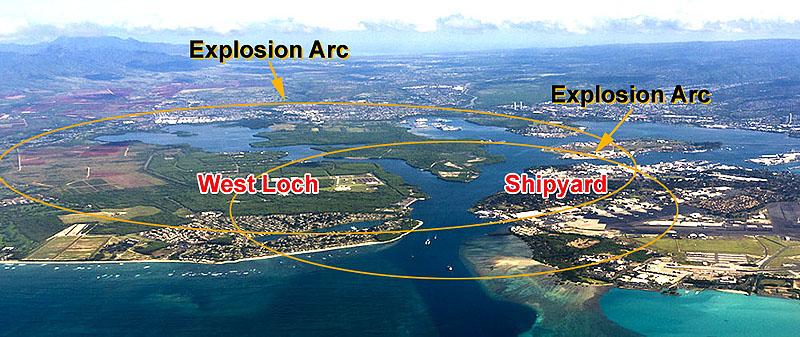
Environmental Impact Statement (EIS) Dry Dock Replacement And Waterfront Production Facility. Major Expansion of West Loch Depot Endangers Pearl Harbor-Hickam

  JOHN M. BOND KANEHILI HUI REPORT AND TESTIMONY Environmental Impact Statement (EIS) Dry Dock Replacement And Waterfront Production Facilit...