Search This Blog

Showing posts with label Waikele. Show all posts

Why are new Army and Navy Magazines Being Built at West Loch?

 Compiled by Ewa Historian John Bond 

Why Are So Many New Army and Navy Munitions Missile Magazines Being Built at West Loch?

This also includes moving ALL of the weapons and munitions stored at Lualualei 

and nuclear weapons which would have been stored at closed Waikele, 

closest To Pearl Harbor


Air photo of the Ewa Plain in 1992. Much smaller population density. Kapolei is just getting started. Much of it was in sugar cane. But today nearly everything not a golf course is crammed with homes, condos and big planned developments. 

The 1995 Hawaii Military Land Use Master Plan (HMLUMP)

Cost of Compliance on Graduate School of Business & Public Policy Thesis, December 2017, Naval Postgraduate School, Munitions Consolidation from Lualualei to West Loch

https://calhoun.nps.edu/handle/10945/58904

In 1967, the Naval Ordnance Safety and Security Activity (NOSSA) came out with more restrictive safety standards mandating that the distance between each magazine must be greater than what is currently installed at West Loch (NAVSEA, 2017). Due to the lack of permissible net explosive weight (NEW) allowed per the NOSSA standards, Navy Munitions Command has been using several magazines in Lualualei to store smaller-sized ordnance.

The 1995 Hawaii Military Land Use Master Plan (HMLUMP) recognized the importance of Hawaii’s strategic location as a “bridge to Asia” and, as a result, recommended the release of the Lualualei Annex due to its aging magazines and its consolidation with West Loch pending construction of new facilities.

The 2002 Commander, Navy Region Hawaii (CNRH) Ordnance Facilities Plan, proposed a significant investment in new ordnance infrastructure for new magazines near West Loch. Additionally, in 2003, PACFLT identified that only four out of 299 magazines in Hawaii are capable of storing modern missiles for naval destroyers and submarines.

Rising tensions in the Pacific with China, North Korea, and Russia

could lead to combat operations in the Pacific.

The West Loch Hawaii’s will need to store additional prepositioned munitions, hold ordnance for ships undergoing repairs, and resupply more deploying ships to the Pacific. The West Loch channel has already been expanded to handle large newer Navy ammunition ships, such as handled by the Army MOTSU site in North Carolina which has a 3.5 mile ESQD safety arc, compared to West Loch which has a very much smaller ESQD and is located right next to many suburban homes in Ewa West Oahu.

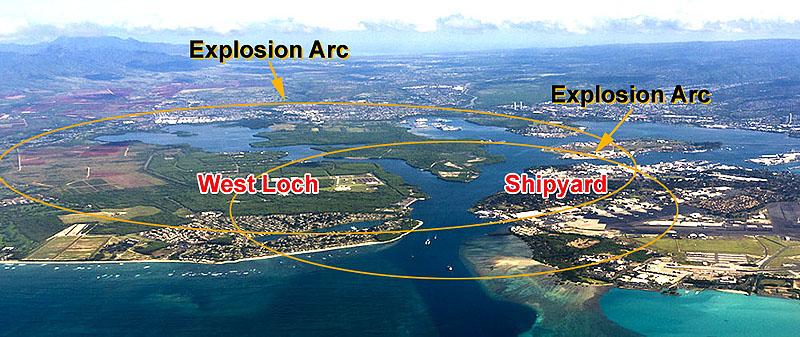
See Figure 3 for the layout of West Loch and shows the explosive safety boundaries associated with ammunition operations. Unlike Lualualei, West Loch is closer to residential areas. Ordnance operations in both Lualualei and West Loch are contracted out and are renewed annually by the Navy.


Major Missile Munitions Complex Plan Cites Just Two Alternatives Available 

The two courses of action according to the Navy’s analysis are as follows:

Option 1. Navy builds new magazines, Army builds new magazines, and both consolidate in West Loch in accordance with NOSSA standards.

Option 2. Current magazines at Lualualei are upgraded to NOSSA standards and current operations remain the same for Navy and Army.

Option 1 may sound reasonable but does not take in account the required ESQD – safety zone, according to information made available to the public in 2018 by the Army MOTSU presentations. The Army munitions complex will be just .5 (1/2 mile) from the nearby communities.


All US Navy destroyers will get hypersonic missiles, says Trump’s national security adviser


The U.S. Navy plans to put hypersonic missiles on all Arleigh Burke-class destroyers, President Donald Trump’s top national security official said Wednesday.

The Navy wants to field hypersonic missiles first on the Virginia-class attack submarine, then on the new Zumwalt-class destroyers, and then finally across the Burkes, national security adviser Robert O’Brien told an audience at the Portsmouth Naval Shipyard in Maine.

“The Navy’s Conventional Prompt Strike program will provide hypersonic missile capability to hold targets at risk from longer ranges,” O’Brien said in prepared remarks. “This capability will be deployed first on our newer Virginia-class submarines and the Zumwalt-class destroyers. Eventually, all three flights of the Arleigh Burke-class destroyers will field this capability.”


West Loch ESQD (safety arc blast zone) Revealed From A Recently Published 2017 Public Document

For the first time the West Loch Blast Zone ESQD has been found. The Navy in Hawaii has never released this map before. All maps shown and documents used here are from US government publications, project analysis and environmental assessments, and are NOT secret or disclosing anything to China and Russia which actually know a lot more about all this than does the local West Oahu community. The communities near these munitions sites deserve to know this information because all this could have a large impact on home construction, building codes, schools, insurance, evacuations, emergency response and much, much more. This was extensively revealed in the 2018 MOTSU disclosures to the communities near it in North Carolina. 


The Navy in Hawaii disclosed the West Loch ESQD in 2003 in an unpublished report. The Navy very often keeps important community information in unpublished reports documents. Sometimes these documents can be found using a FOIA process (Freedom of Information Act.) However the West Loch blast zone safety arc of 2003 was revealed and can be found in this university thesis: Cost of Compliance on Graduate School of Business & Public Policy Thesis, December 2017, Naval Postgraduate School, Munitions Consolidation from Lualualei to West Loch.

The thesis is a rationale for moving Army munitions to West Loch and consolidating them all with new Navy Type D storage units that will be built for missiles. In the analysis a number of significant new maps were revealed for the first time in a public document.


The Navy 2003 blast zone arc map has been annotated in red to show the public what is currently there and what is planned to go in soon. None of this is classified information and details can be found in public documents on the internet. The Navy policy concerning “special weapons-AKA nukes” is that they will neither “confirm nor deny” that nuclear weapons are stored in a specific location. The obvious indicator most used is to look for a double high security fence around the site. Waikele was once also a known site for storing nuclear weapons and had very high security and double fencing. Today it is generally known that intercontinental ballistic missiles for Navy submarines are stored and loaded in a remote area in Bangor, Washington.

Unsafe ESQD - Why Do Other Army and Navy Ammunition Piers and Weapons Areas Have Much Larger Safety Arcs?


Naval Magazine Indian Island

https://www.kitsapsun.com/story/news/2017/11/26/little-known-island-logistics-backbone-pacific-northwest-navy-fleet/886272001/


Naval Magazine Indian Island is the only deep water ordnance facility on the West Coast with no access restrictions, such as shallow bridges or water. The island has a 1,650-foot-long pier with 55 feet of draft available at the average low-tide height of water, making it so the Navy can load munitions onto any vessel in the fleet docked at the island's pier.  

It has more than 100 magazines that store conventional weapons, ranging from small arms ammunition to aircraft ordnance and is located in a fairly remote area of Washington State on an island.


 E. NMCPAC CWD DET INDIAN ISLAND Indian Island is a command located in the Pacific Northwest that has the same roles and responsibility as NMCPAC EAD DET PH.


The island itself is 2,700 acres and serves as the Navy’s only deep water port on the West Coast of the United States with the capability of loading munitions for all U.S. military branches. Indian Island is also the U.S. military’s largest ordnance storage site on the West Coast, handling small arms ammunition, artillery shells and missiles (P. Guerrero, 2016).


Although Indian Island does not have the same volume of vessels as Pearl Harbor, their ordnance tonnage is very similar. Indian Island comprises active-duty military and government civilians who handle all the ammunition and explosives.


Naval Ammunition Depot Earle


https://www.wikiwand.com/en/Naval_Weapons_Station_Earle


On August 2, 1943, construction began on Naval Ammunition Depot Earle, named after Rear Admiral Ralph Earle, the chief of the Bureau of Ordnance during World War I. The depot was commissioned on December 13, 1943, though work continued on the military road and railway connecting the mainside complex, the waterfront complex and the pier, which stretches 2.9 miles (4.7 km) into the Sandy Hook Bay.

Earle continued to develop after World War II, keeping pace with the changing needs of the navy. In 1974, the depot's name was changed to Naval Weapons Station Earle.


Pier Complex: The station's pier complex is one of the longest "finger piers" in the world. A two-mile (3 km) trestle connects to three finger piers. One mile from the shore the trestle branches off to Pier 1. At the junction of Piers 2, 3 and 4, a concrete platform supports a forklift/battery-recharging shop and the port operations building. This area is known as the "wye."


https://en.wikipedia.org/wiki/Black_Tom_explosion


http://members.trainweb.com/bedt/milrr/earlenws.html


https://fas.org/man/dod-101/fac/port/earle.htm


https://tworivertimes.com/land-conservation-surrounding-nws-earle-could-grow/


https://americasfireboat.org/history/ss-el-estero/


Due in large part to the secrecy surrounding the events of El Estero’s loss, her story remains largely unknown to the general public, but her untimely demise has left a very visible legacy in the waters around New York, specifically in Sandy Hook Bay. In August 1943, the U.S. Navy began high-priority construction of a new ammunition depot now known as Naval Weapons Station Earle which features a 2.9-mile pier designed to move the hazardous activity of loading and unloading munitions away from densely populated areas.  


NMCPAC EAD DET PH Headquartered in Ewa Beach, HI

https://dair.nps.edu/bitstream/123456789/2273/1/NPS-LM-18-023.pdf

NMCPAC EAD DET PH Headquartered in Ewa Beach, HI, on the island of Oahu, NMCPAC EAD DET PH consists of two branches: the Lualualei Branch on the western side of Oahu 35 miles northwest of Honolulu, and the West Loch Branch (West Loch and Waipio Point) located about 20 miles west of Honolulu.


Combined, these facilities contain 386 magazines—large, earth covered storage facilities—with a storage capacity of approximately 98,830 short tons (NAVSUP Fleet Logistics Center Pearl Harbor, 2017). Figures 1 and 2 present some of the storage magazines located on Lualualei and West Loch. The Command safely and effectively receives, stores, segregates, and issues ammunition stock for the military and other government entities.

NMCPAC EAD DET PH also provides pier-side ordnance handling in the Pearl Harbor area for military and commercial vessels of all types, foreign and domestic, as well as services to other military commands at their respective sites.

Material is on/off-loaded onto a variety of ships at various locations on and around Pearl Harbor. The West Loch wharves, Pearl Harbor piers, and Ford Island are common locations for on- and off-loading material. Types of ships include various combatant ships, small boats and submarines; Navy cargo and supply ships (T-AKE and T-AOE); chartered vessels; and U.S. Army and U.S. Marine Corps roll-on/roll-off (RORO) vessels.


Waikakalaua Ammo Storage Sites (WASS) History

 Histories Compiled By Ewa Historian John Bond

Waikakalaua Ammo Storage Sites (WASS) History 

Oahu has many huge and numerous underground concrete WW-II tunnels for mostly storing ammunition


Waikakalaua Gulch Army ammunition storage tunnels are massive, large enough to drive fully loaded 2 1/2 ton Army trucks. Army concrete ammunition tunnels have been estimated to total at least 16 miles in length, from Koko Head to Moanalua.

No deaths but the explosion was massive in Army

Waikakalaua Gulch Tunnel #24A in 1946


Waikakalaua Ammo Storage Site (WAS) Storage Tunnels (WAST) This installation extends beyond the southern extreme of Wheeler Army Airfield, along the east slope of Waikakalaua Gulch, at the west edge of the community of Mililani. The facility was constructed during WWII and is presently in mothballed status. It consists of a series of steel-doored, horizontal storage bunkers tunneled into the steep gulch wall. Access is from a roadway constructed just above the OR&L right-of-way that once connected Waipahu to Wheeler, Schofield, Wahiawa and the Dole Pineapple operations to the north (until the rail system was abandoned in 1947-48). This system of tunnels was the location of the primary storage for ordinance for B-17s and other bombers stationed just above at the Kipapa Army Airfield.


Figure 88: Kipapa Army Airfield, April 1943. This area is now part of Mililani Town. Runway 3 roughly paralleled the lower ends of Kealakaa Street and Meheula Parkway, extending up to the latter intersection with Kamehameha Highway. The Ammo Storage Tunnels can be seen as a series of black openings along the roadway along the gulch bottom.


The Army Corps of Engineers contracted out for a Historical Records Review of the Waikakalaua Ammunition Storage Tunnels (WAS), Draft Historical Records Review, Waikakalaua Ammunition Storage Tunnels - TLI Solutions, Inc. August 2006). Excerpts from sections on the data collection and document review process as well as one of their maps of the installation.


Waikakalaua consisted of 52 tunnels built into the hillside and used for ammunition storage. Waikakalaua Ammo Storage Tunnels (WAST) 1944 1946 176.1 acres. The mission of Waikakalaua was to provide ammunition storage for the Army during and after World War II. Ordnance storage tunnels and underground fuel storage tanks are reported to have been constructed between 1942 and 1945, and the installation was active until the 1950s. Waikakalaua Ammo Storage Tunnels as AIR/FALLOUT SHELTER Building FEE NREC Contributing Element of NRE District (NREC) An individual facility that is identified as a contributing element of a larger district determined eligible for listing on the NRHP.

According to Army-Navy Explosives Safety Board Abstract Number 28, tunnel #24A exploded in 1946 blowing large pieces of the concrete baffle out of the tunnel and across the gulch with such force that it destroyed a railroad track 300 feet away and caused a 20-foot depression to form above the tunnel.

As WW II approached, portable storage units were replaced with extensive underground rooms and tunnels for ammunition storage at many locations on Oahu. One worker commented that the Engineers had built so many tunnels, if placed end to end– the entrance would be at Koko Head, the exit at Moanalua. (ACE)

A major defense project of the mid-1930s was the construction of ammunition tunnels into the sides of Aliamanu Crater, called Aliamanu Ammunition Storage Depot (now Aliamanu Military Reservation Intended for centralized storage of Army ammunition, eight tunnels were dug in 1934 and additional 35 magazines were completed in 1937. (Army)

At the onset of World War II, the Army was importing ammunition in huge quantities, requiring construction of ammunition storage facilities. Small facilities were built above ground, but the bulk of the ammunition was stored in massive underground storage facilities.

The first to be developed was in Waikakalaua Gulch just south of Wheeler Field, as well as at Kipapa Gulch.

“Tunnels driven into the almost vertical walls of the two gorges would have entrances invisible from the air. To keep out bomb fragments, passageways to the storage chambers would be dog-legged or provided with baffles.”

“The only drawbacks to these sites were lava formations and cinder pockets which would necessitate timbering or concreting considerable portions of the chambers.” (DOD; army-mil)

Waikakalaua consisted of 52 tunnels built into the hillside and used for ammunition storage. The mission of Waikakalaua was to provide ammunition storage for the Army during and after World War II. Ordnance storage tunnels and underground fuel storage tanks are reported to have been constructed between 1942 and 1945, and the installation was active until the 1950s.


The extensive Waikele Tunnel Complex was given away by the Navy in the Ford Island land deal orchestrated by Sen. Inouye and Rep. Abercrombie in 2003

This system of tunnels was the location of the primary storage for ordinance for B-17s and other bombers stationed just above at the Kipapa Army Airfield. The site was also used to store anti-tank and rifle fragmentation grenades. (army-mil)

Kipapa Ammunition Storage Site, located in Kipapa Gulch, was comprised of three sections. The lower unit is accessed from the south side of the Kamehameha Highway Bridge and extends south to the Kipapa Navy Ammunition Storage Area. The other two units are in the gulch to the east of Mililani Town.


By WW-II's end, the Army had built 37 miles of runways, 32 miles of taxiways, 2.7 million square yards of aircraft parking, and 470 aircraft bunkers.

Fort Ruger – Fort Shafter Tunnels

Other tunnel complexes were built, including Schofield Barracks, Wheeler Field, Fort Shafter and Fort Ruger. The tunnels at Wheeler Field and Fort Ruger were for ammunition storage. The tunnels at Fort Shafter included a bombproof radio station, an underground cold storage facility, an anti-aircraft command radio transmitter tunnel, and the Air Defense Command Post. (army-mil)

In connection with Richardson Hall there are three underground, bombproof tunnels in its vicinity. Tunnel 103 is presently a command center, while the current uses of tunnels 113 and 114 are unknown. National Register of Historic Places Inventory Fort Shafter.

Kunia Tunnels

Army construction during this period also included “The Hole” (now the Kunia Field Station,) a facility originally intended for airplane assembly (with a runway connection to Wheeler Field to the east.)

“The entrance appeared to lead only to a small dugout in a rolling hill, but at the end of a quarter-mile tunnel two elevators – one big enough for 20 passengers and the other able to carry four ½-ton trucks – gave access to a three-floor structure, self-sufficient even to a cafeteria that could serve 6,000 meals a day.”

“’The Hole’ was intended for plane assembly, but since it was not needed for such use, it proved ideal for the reproduction of maps and charts. Its huge air conditioning and ventilating systems provided easy control of temperature and humidity, and its fluorescent lighting furnished a flood of shadowless illumination.” (Allen; army-mil)

Kunia Regional SIGINT Operations Center

https://en.wikipedia.org/wiki/Kunia_Regional_SIGINT_Operations_Center


http://totakeresponsibility.blogspot.com/2013/10/the-hole.html

In a first, NSA allows news cameras into Kunia facility. And vets aren’t happy

https://www.hawaiinewsnow.com/2019/05/21/kunia-veterans-say-theyre-shocked-still-ignored-after-top-secret-nsa-tour/

Aliamanu Crater Tunnels

http://www.rcarchive.com/hhg/alia.html


In October 1941, work was started to convert the storage facility in the rim of Aliamanu Crater into a joint Army-Navy command post; although not completed at the time of the Japanese attack on Pearl Harbor, the post was shortly after put into service by the island command.

To alleviate continued housing shortages in the early-1970s, the Army, Navy, and Marines developed a joint project at Āliamanu Military Reservation, once a World War II era Navy-Army command post and important ammunition storage facility.

The ammunition was moved to the Lualualei storage depot and the crater was transformed into a 2,600-unit housing development.

You can get an idea how HUGE these Waikakalaua Ammo Storage tunnels are by looking about halfway into this hike video


https://www.youtube.com/watch?reload=9&v=RClHh4gO6Q0

Apparently some ordinance cleanup was or will be done by 2015-20??

https://aec.army.mil/application/files/4715/0007/9167/HI-WAIK.pdf

http://imagesofoldhawaii.com/ammo-tunnels/

World War II fortifications still present on O'ahu


"I suspect that if you were to use the term 'Gibraltar of the Pacific,' you could get away with that without much argument," historian William Gaines said. "At the end of World War II, O'ahu was probably the most heavily armored island in the world."

There are far more batteries and bunkers out there than meet the eye. Many who have had access to them discover inside them more than an echo and moldy interior.

"We're surprised every day. We find more and more," said John Bennett, a retired city prosecutor's investigator and member of the Coast Defense Study Group.

The military controlled one-third of O'ahu during the war years, and one Army official said there are probably 300 tunnels.

Sandii Kamaunu, owner of Military HQ on Sand Island Access Road, several years ago bought up a Civil Defense field hospital stored and long forgotten since the early to mid-1950s in a World War II gun battery in Kailua. She was flabbergasted by what she found.

The cache included hundreds of sealed crates. There were 200 cots and 200 wool blankets, splints, blood transfusion kits, porcelain bed pans and urinals, and vials of dried-up potassium penicillin crystalline for shots that Kamaunu says were given with "horse needles that hurt like hell." Some of the items bore 1940s dates.

All were like new, in the box, directions included.

Wayne Jones, the acting director of the O'ahu Civil Defense Agency, remembers inspecting the supplies.

"There was an old dentist's chair up there if I remember correctly, an old operating table — all stainless steel — but of no use to us," Jones said.

For decades, Ron Deisseroth and his mushroom business co-existed with the field hospital in twin 155-foot-deep bunkers, a spot that suited both. Sheltered beneath at least 200 feet of earth at the deepest point, Battery 405 — with kitchen, infirmary and bunks — originally supported two MK VI 8-inch Navy guns. Five similar batteries were built around the island. A facade meant to look like a two-story home — intended to throw off would-be invaders — once camouflaged the tunnel's entrance.

Deisseroth, who grew mushrooms from 1950 to about 1992, remembers schoolchildren trooping up the hill for a disaster preparedness drill.

"I guess they wanted them to know where to go in case of an attack," said the O'ahu man, who leased the property from Kane'ohe Ranch.

There are also many large tunnel systems on Oahu for 

Artillery Gun Batteries to support 8 and 14 inch guns


Environmental Impact Statement (EIS) Dry Dock Replacement And Waterfront Production Facility. Major Expansion of West Loch Depot Endangers Pearl Harbor-Hickam

  JOHN M. BOND KANEHILI HUI REPORT AND TESTIMONY Environmental Impact Statement (EIS) Dry Dock Replacement And Waterfront Production Facilit...